gforsythe.ca

June 11, 2010

Graphic Facilitator

Filed under: Higher Ed,University,social media — admin @ 10:56 am

I’ve always loved drawing, scribbling, doodling, taking notes and making meaning through visual representation. I recently reacquainted myself with my watercolour set and started painting again. In the beginning, around the holidays, I was using it just for greeting cards and later to represent images that I couldn’t find online.

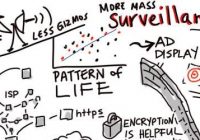
Specifically for my Harbourside Hangout presentation at CNIE with Kyle Mackie, I was looking for a bunch of images that represented the voices of dissent about twitter: it’s narcissistic, self indulgent; it could cause academics to lose control of the conversation. I was lucky enough to have a few face to face conversations with Alec Couros. Having seen his Flickr stream I had asked about the illustrations. I was particularly struck with the ripping through the tools graphic. It resonated with me because it spoke to our consumerist society, even with *free* items as we are constantly jumping from one tool to the next, in search of the next best thing, without pause for reflection, much like kids on Christmas morning. He told me he drew it and it became clear: if you can’t find the image, make the image. It seems so simple but it honestly seemed too time consuming. As soon as I returned from CNIE, I set down to paint those pictures, old fashion style, watercolour and paint brushes.

I recently tweeted the academia pic while following Mark Greenfield‘s Penn State presentation: Social Media Summit II – Higher Ed, Social Media and the Law.  From that, my Twitter friend and fellow Sakai-phile from Oregon Randy Thornton suggested I check out Nancy White and my conference & twitter friend from Northern B.C., Grant Potter suggested I check out Rachel Smith. I was absolutely blown away.

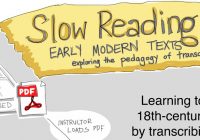
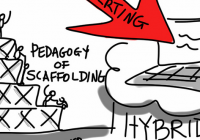
The first most interesting thing to me was to find out that there is even such a thing as ‘graphic facilitation’ and there’s even a site for International Visual Practitioners. This excites me beyond belief. A lot of my facilitation during the Instructional Skills Workshops deals with quickly capturing the moment of feedback from a group of peer learners and representing it back to the peer teacher. ISWs are the single most important teaching professional development for anyone responsible for communicating information to another person; they are both exhausting and immensely rewarding. I welcome with open arms any tool or process or that could enhance my ability to be a more effective ISW faciliator.

I have tried with some success to use graphics during the ISW but I would really love to do this in more systematic, organized way. I did try taking notes using LiveScribe pen for a computer science prof, with limited success. I do also think there is enormous potential for this in education, particularly for visual learners in distance education.

One of the many other people I enthusiastically shared these resources with was my fellow ISW facilitator, mentor, and supervisor. She had just returned from Naramata Spring Institute and had a session on this! Oh, the synchronicity! She is also excited for its potential in education. Now I’m grappling with the paper vs technology debate. I have a tactile affinity for paper and markers but never know what to do with it all in the end. Seeing Rachel Smith’s iPad graphic facilitation is *almost* alluring enough to draw me to the dark side and throw away all the reasons I posted why I would never have an iPad. Apparently there is research on how much paper is needed for a particular amount of time. I’m going to have to try both and decide for myself. I look forward to my future meaning-making via graphic facilitation.

Finally, on a meta level, this is fascinating example of how powerful these networks can be, in particular, the vainglorious twitter. It is a convergence of interests purely because we share similar interests. In the past, our circles probably would never have intersected due to geographic, personal and temporal variations. With a tool as brief and unimposing as twitter we increase our chance encounters and are able to share interesting tidbits of the worlds we inhabit without imposing ourselves in any overwhelming way. The results are fascinating.

Someone said recently that Twitter is their number 1 most important professional development tool and I’m starting to agree

February 5, 2010

Well, since you asked…

Filed under: University — admin @ 12:01 am

I recently joined the Contact North Training initiative which is hosted by their new Chief Innovation Officer, Stephen Murgatroyd inside the social networking space, Ning.

Stephen posed the question about our thoughts on Apple’s new iPad. Of course, in the past week, it’s been impossible to not view a million different opinions.  So, thank you for asking, because this time, I think I actually do have an opinion on this.

Here’s my response:

I love the aesthetic of Apple as much as the next person. The iPhone really changed the way people do things (my brother constantly calls it a “game-changer”) and I love my mac laptop, however, I am not ready to pre-book my iPad just yet.

There’s an organization called Defective by Design and they are dubbing the iPad the “iBad” because of the way Apple handles Digital Rights Management (DRM). Basically DRM puts locks on content.

I have recently watched RiP: A remix manifesto on the National Film Board of Canada’s website and it reminded me the importance of why content needs to be free. The first key point in the manifesto: “Culture always builds on the past”. Throughout the history of humanity, we have built on the knowledge from those before us. Yet in this past century, we have found ourselves allowing corporations to take ownership of our content. Not creators but corporations are locking us out of our own culture.

Now you don’t have to wake up every morning and sing the Free Software Song or be a card carrying member of the Electronic Frontier Foundation to see the value in free and open content.

The iPad is not designed for content creation. It is designed for content consumption. It shifts back to “read only” from the read write web.

This is the beginning of what some are calling the dawn of the Splinternet, where more content is moving behind logins and password.

BBC News summarized this best:

“At the heart of this and many other fights lies an attempt to limit the ways in which the network and the computers connected to it can be used, and to do so in ways that serve the interests of corporations.
These interests may sometimes be aligned with those of the wider public, but that alignment is conditional and contingent and cannot be relied upon, which is why it must always be challenged.”

So, personally, I’m going to take the advice of all these wise folks’ blogs I’ve been reading.

I’m going to choose my devices carefully and I’m going to let vendors know that DRM is not okay.

I’m looking for a device that is elegant and open, usable and free. If Apple takes the iPad in that direction, then I’ll be happy to jump on the bandwagon.

October 30, 2009

Dangers of infrequent blogging

Filed under: Lifelong Learning,University — admin @ 4:10 pm

Probably 6/10 blogs have the initial post with some lofty goals about what the purpose, audience and intent of said blog. Why should this one be any different?

Up until this September, I wasn’t too motivated to write about anything really, then I received a phone call from Helen from the Botshaft von Kanada. She invited me to speak in Berlin, Germany at a conference for German academics and administrators interested in the integration of lifelong learning into universities’ missions. She felt that as president of the Ontario Council for University Lifelong Learning that I was a suitable workshop presenter to represent Canada. There was going to be one presenter each from Canada (me), Australia (Krishna Sen), U.S.A (Sherryl Weems), U.K. (Tom Schuller).

I rushed to the passport office with my application and photo and within 6 days it was official – I could travel out of the country. My flight and hotel were booked for me and all I had to do was come up with a presentation that represented the state of lifelong learning in Canadian Universities. Oh, is that all?

The conference organizers sent some leading questions to keep the presenters on track which I shared widely- with my colleagues from my institution, OCULL, CAUCE, anyone who would stop and talk to me about lifelong learning. Many people contributed a lot of reading material, advice and input; so much that at the end, I felt that I was a mere messenger and that the workshop presentation was a collaborative effort from many experts.

I read and made notes for a solid 6 weeks and rarely slept due to the sheer excitement of the upcoming presentation. I put so much work into this project that it consumed a portion of me. So after returning from Berlin, I felt the only reasonable thing to do would be to encapsulate this workshop by writing it all out and make it public. I’ve been told that anything I put on the web then becomes “published” and then is no longer eligible for “real” publication. I guess that’s a risk I should take. It would be ridiculous to keep all this research sequestered away from anyone interested in knowing more about it.

Powered by WordPress